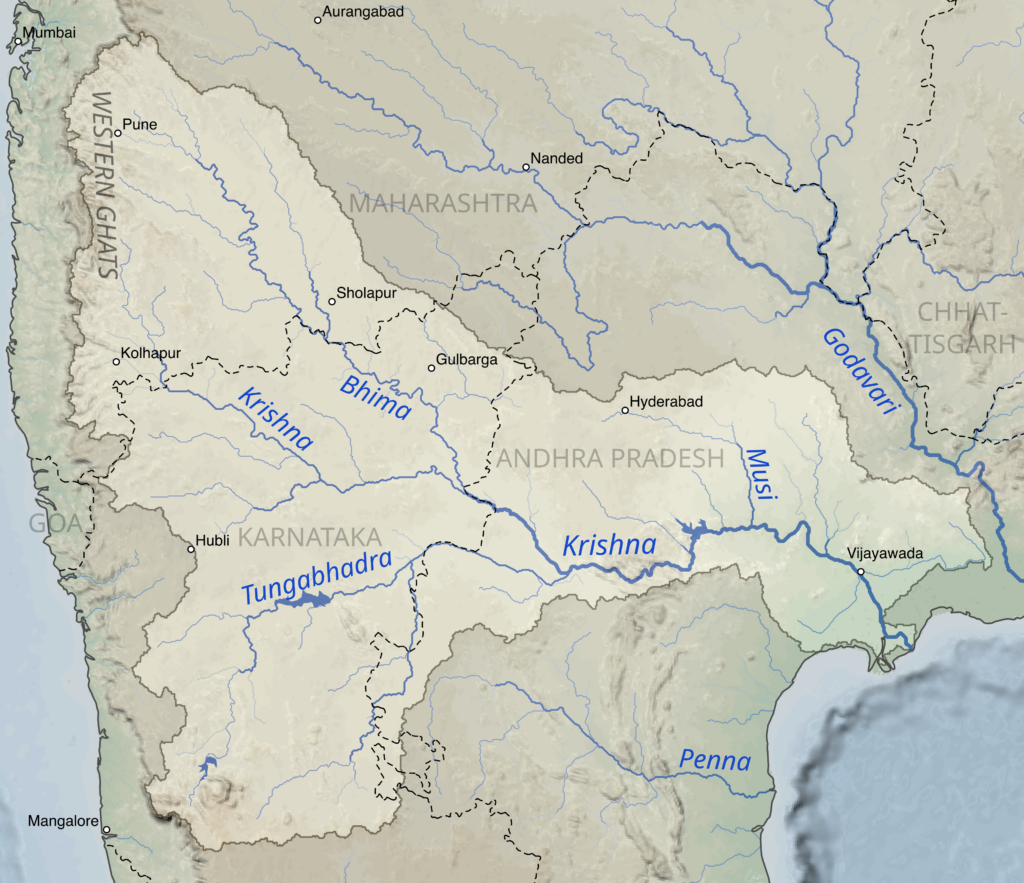
The city of Hyderabad, now the capital city of Telangana, has a great history. Situated on the banks of Musi river, which is also known as Muchkund.
References
Muchkund Dubey
Muchkund Dubey (1933 – 26 June 2024) was an Indian diplomat and Foreign Secretary, the administrative head of the Indian Foreign Service, Government of India from 20 April 1990 – 30 November 1991. Dubey served as President of the Council for Social Development (CSI), and Chairman of the Asian Development Research Institute, Patna. He was also a Professor in International Relations at the Jawaharlal Nehru University, Delhi and a Professor Emeritus at the Foreign Service Institute.[4]
Dubey died on 26 June 2024, at the age of 90.[5]
1989 to 1991 – Three governments
Between 1989 and 1991, India experienced significant political instability, transitioning from the end of the Rajiv Gandhi government to a series of short-lived minority coalition governments. The three distinct governments during this period were:
- V.P. Singh (National Front – December 1989 to November 1990): Following the 1989 general election, V.P. Singh formed a coalition government, the National Front, with Janata Dal as the primary party. This minority government was supported by the BJP and the Left Front from the outside. This period is notable for the implementation of the Mandal Commission report.
- Chandra Shekhar (Samajwadi Janata Party – November 1990 to June 1991): After the BJP withdrew support from the V.P. Singh government, Chandra Shekhar broke away from Janata Dal to form the Samajwadi Janata Party. He became Prime Minister with outside support from the Indian National Congress.
- P.V. Narasimha Rao (Indian National Congress – June 1991 to May 1996): Following the 1991 elections—held in the wake of Rajiv Gandhi’s assassination—the Congress party returned to power, with P.V. Narasimha Rao heading a minority government that eventually completed a full term.
This period was a pivotal point in Indian politics, marking the transition into an era of coalition governments and the beginning of major economic reforms in 1991.
India intends to extend its 1971 treaty of friendship with the Soviet Union when the pact expires in August, an Indian news agency reported today from Moscow.
India’s Foreign Secretary, Muchkund Dubey, discussed the extension of the pact with Soviet officials in a visit to Moscow this week before going on to Washington, the Press Trust of India said.
On Friday, officials in New Delhi said that the Indian-Soviet treaty was not on the agenda in the Moscow talks. Diplomats said that there has been no review of foreign policy in India after the upheavals in Eastern Europe and the war in the Persian Gulf.
Under three Governments in the last year and a half, New Delhi has clung mostly to a policy of nonalignment without defining what that means in a changed world. In the process, India, which now holds one of the non-permanent seats on the United Nations Security Council, has been relegated to the sidelines of international affairs.
The New York Times – https://www.nytimes.com/1991/03/24/world/india-seeks-to-extend-treaty-with-soviets.html
Iraq war and India US relations
Diplomats here say Mr. Dubey is visiting Washington at a time of strain in Indian-American relations because of widespread Indian opposition to the American-led war against Iraq, India’s closest friend in the Muslim world.
Indian intellectuals have led a campaign of condemnation, saying among other things that the world is threatened by American “neocolonialism,” which one writer recently described as the product of an inferior, materialistic civilization. Any support for the allied war effort has been castigated in editorials as inimical to Indian neutrality.The New York Times – https://www.nytimes.com/1991/03/24/world/india-seeks-to-extend-treaty-with-soviets.html
Inferior, materialistic civilisation
The concept of an “inferior, materialistic civilization” is a critique often leveled against modern, Western-centric, or industrial societies, suggesting that a heavy focus on material progress, technological advancement, and consumerism leads to a decline in spiritual, moral, and social values. This perspective contrasts “materialistic” civilizations with those deemed “spiritual” or “traditional”.
Key Arguments and Perspectives
- Critique of Modernity (Gandhian View): Mahatma Gandhi regarded modern (specifically Western) civilization as inferior because it prioritizes material luxury over ethical living and self-restraint. In this view, a civilization focused on “endless wants” and industrialism is considered inferior in sustaining true human happiness compared to a simple life rooted in moral values.
- The “Inferior” Material Nature: Some philosophical and spiritual viewpoints, such as those found in the Bhagavad-gita, distinguish between the inferior material nature (which is transitory and superficial) and a superior spiritual nature. A civilization solely focused on material accumulation is deemed “inferior” because it neglects the higher, non-physical realities of existence.
- Societal Consequences: Critics argue that materialistic societies experience increased crime rates, erosion of community values, and increased political instability due to widening gaps between the rich and poor.
- Anti-Humanistic Interpretation: Materialistic philosophies are sometimes viewed as “anti-human” because they reduce human beings to mere consumers or objects, equating human value with material possessions.
- Contextualizing Materialism: While some view materialism as inferior, it is also defined in sociology simply as the reliance on physical objects, technology, and economic systems to organize society. Some arguments suggest that modern, efficient technology (like cars or planes) makes modern civilization “superior” in a quantitative, mechanical sense, despite lacking spiritual depth.
Common Characteristics Cited
Conflict and Degradation: Increased social strife and dehumanization.
Excessive Industrialism/Consumerism: Focus on production and consumption.
Loss of Tradition: Abandonment of ancestral wisdom, simplicity, and self-restraint.
Inner Emptiness: A sense of psychological or spiritual void despite high material standards of living.
The fall of Chandrashekhar government
Although the caretaker Prime Minister, Chandra Shekhar, did not join in this criticism, two former Prime Ministers, Rajiv Gandhi and V.P. Singh, did. Under pressure, Mr. Shekhar was forced to withdraw permission for American transport planes to refuel in India. The refueling issue was a factor that helped lead to the collapse of Mr. Shekhar’s minority Government this month.
The Kashmir issue and the US Ambassador
As Mr. Dubey reached Washington, a new irritant was introduced. Indians are accusing Robert Oakley, the departing American Ambassador to Pakistan, of changing United States policy on Kashmir by telling a Kashmiri-American group in a letter that Washington regards the region as disputed territory. Plebiscite Requests Ignored
This has always been American policy, because United Nations resolutions calling for a plebiscite on Kashmir have been ignored by India. But a restatement of the position was enough to rekindle controversy here.
Indo-Soviet treaty and “non-alignment”, the Bangladesh war
The Indian-Soviet treaty is similar to Moscow’s pacts with Iraq, Syria and some Communist bloc nations and undercuts India’s claims to nonalignment during the cold-war era. It would normally have been extended by five years, but Mr. Dubey, permanent head of India’s Ministry of External Affairs, told reporters in Moscow that the new term of the treaty would be longer.
Some diplomats say the treaty could be extended up to 20 years and is unlikely to be subjected to parliamentary debate because India is ruled by a minority caretaker Government, and elections are expected in May.
Of all parties in the campaign, only one, the conservative Bharatiya Janata Party, might be expected to question the automatic extension of the treaty when a new Parliament assembles in June.
India and Moscow signed the pact during a period of crisis in what is now Bangladesh, where Indian troops intervened on behalf of Bengali separatists and succeeded in splitting Pakistan in two. East and West Pakistan were culturally and geographically different areas joined into one Muslim nation by the 1947 partition of British India.
India, placed between them, had been concerned since the 1950’s about the growing military relationship between the United States and Pakistan. Americans were accused of threatening India in 1971 with a show of naval force in the Bay of Bengal during the Bangladesh war.
Pakistanis, however, also criticized Washington for not coming to their assistance as an ally in the conflict.
All excerpts from New York Times article – https://www.nytimes.com/1991/03/24/world/india-seeks-to-extend-treaty-with-soviets.html – a good example of rich journalistic writing with references and cross references.
The Musi river
The Musi River, also known as Muchukunda or Musunuru river,[1] is a major tributary of the Krishna River in the Deccan Plateau, flowing through Telangana, India. Hyderabad stands on the banks of the Musi River, and the river divides the historic Old City from the newer part of the city. The Musi flows into Himayat Sagar and Osman Sagar, which are artificial lakes that act as reservoirs that once supplied the twin cities of Hyderabad and Secunderabad with drinking water. The Musi originates in the Ananthagiri Hills, near Vikarabad. It generally flows towards the east, turning south at Chittaloor. It flows into the Krishna River at Vadapally near Miryalaguda in Nalgonda district.