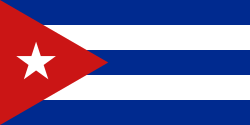
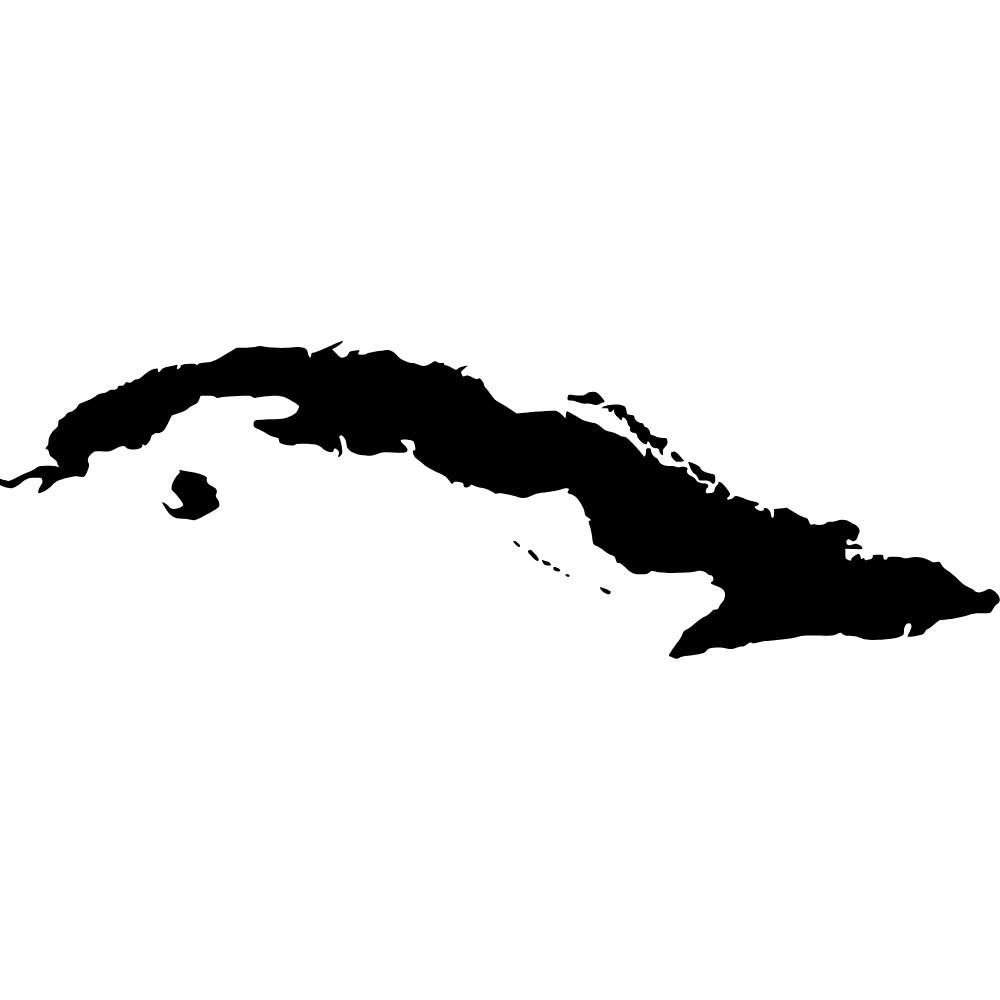
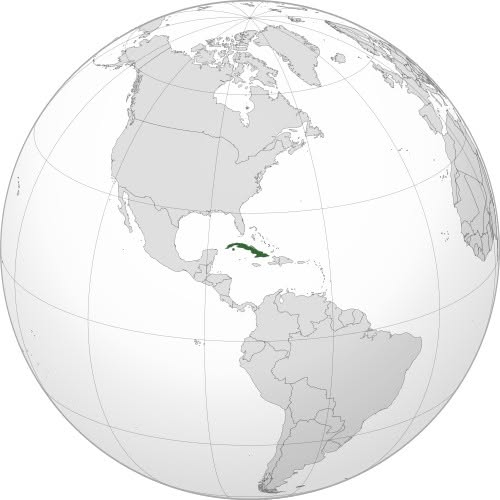
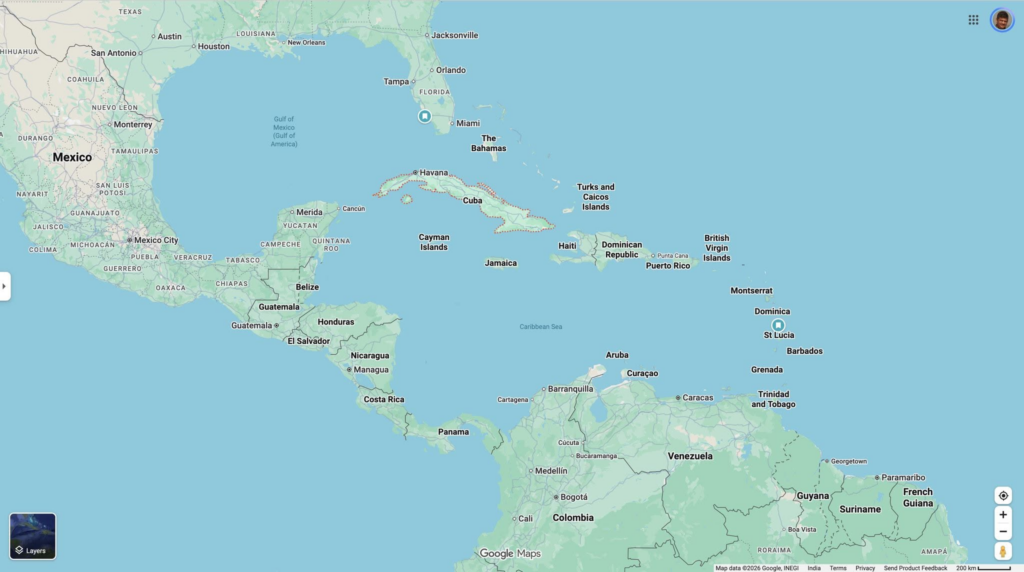
| Country | Cuba |
| Capital | Havana |
| Continent | North America – Caribbean islands |
| Coordinates | 22° N 80° W |
| Neighbouring couintries | North: United States (specifically the Florida Keys, roughly 90 miles or 145 km away) North-East: The Bahamas and the Turks and Caicos Islands (a British Overseas Territory) East: Haiti South-East: Jamaica South: The Cayman Islands (a British Overseas Territory) South-West: Honduras and Nicaragua (across the Caribbean Sea) West: Mexico (specifically the Yucatán Peninsula) North-West: United States (specifically the state of Florida) Because Cuba is an archipelago, it shares no land boundaries with any country, though its maritime borders intersect with those of the nations listed above. |
| Area | 1,10,860 sq. km. |
| Population | 2022 – 1.11 crores. |
| Density of Population | 89.8 / sq km |
| Language/s | Spanish, Haitian Creole |
| Religion | Majority Christians, few non-religious and followers of folk religions. |
| Type of State | Unitary, Communist |
| Type of Government | Non-democratic, mix of Parliamentary and Presidential. |
| Political Party System | One Party System |
| Currency | Cuban Peso CUP |
| Internet TLD | ,cu |
| HDI | 0.762 – High |
| Time Zone | UTC −05:00 • Summer (DST) UTC. −04:00 |
- Leaders
- Fidel Castro (born August 13, 1926, near Birán, Cuba—died November 25, 2016, Cuba) was the political leader of Cuba (1959–2008) who transformed his country into the first communist state in the Western Hemisphere. Castro became a symbol of communist revolution in Latin America. He held the title of premier until 1976 and then began a long tenure as president of the Council of State and the Council of Ministers. He handed over provisional power in July 2006 because of health problems and formally relinquished the presidency in February 2008.
- Miguel Díaz-Canel (born April 20, 1960, Villa Clara province, Cuba) is a Cuban politician who served as president of Cuba (2018– ) and secretary-general of the Communist Party of Cuba (2021– ). He was Raúl Castro’s handpicked successor for both positions. Born a year after the Cuban Revolution, a loyal, effective functionary who rose steadily through the ranks of the party, Díaz-Canel was the first person since the 1959 revolution not named Castro to hold either of the country’s leading posts.
- Raúl Castro (born June 3, 1931, Holguín province, Cuba) is a Cuban politician and revolutionary who served as head of state of Cuba (acting president of the Council of State and the Council of Ministers, 2006–08; president of the Council of State and the Council of Ministers, 2008–18) and defense minister (1959–2006) and who played a pivotal role in the 26th of July Movement, which brought his brother Fidel Castro to power in 1959.
- Time Zone –
- Calling Code
Capital – Havana
Caribbean islands, Americas
Small Island country
10.89 million people
• Density
89.8/km2 (232.6/sq mi) (125th)
GDP (PPP) 2015 estimate
• Total
$254.865 billion
• Per capita
$22,237
Spanish is the official language
Majority Christians, Few with No religion and still others follow Folk religions
Communist country
• Current constitution
10 April 2019
Time zone UTC−05:00 (CST)
• Summer (DST)
UTC−04:00 (CDT)
Date format dd/mm/yyyy
Calling code +53
ISO 3166 code CU
Internet TLD .cu
Currency Cuban peso (CUP)
Some facts
Fidel Castro ruled Cuba from 1959 to 2008
Till 1976 he was the Prime Minister and then The President. In 2008 he formally transferred power to his brother, Raúl, due to failing health. Became independent from Spain in 1868.
• Cuban Revolution
26 July 1953 – 1 January 1959