Jag Badal Ghaluni Ghav, Sanguni Gele Mala Bhimrao
Tukaram Bhaurao Sathe (1 August 1920 – 18 July 1969), popularly known as Anna Bhau Sathe, was a pioneering social reformer, Marxist-Ambedkarite thinker, folk poet, and one of the founding figures of Dalit literature in Maharashtra. Lokshahir and Sahityaratna were the titles given to him1
Notably, today, August 1, marks his birth anniversary.
Early Life and Background
Sathe was born into the Matang caste (a Dalit community historically subjected to untouchability) in the village of Wategaon, Sangli district. Due to severe caste discrimination, his formal education lasted barely a week. In 1931, following a devastating drought, he and his family migrated on foot to Mumbai—a grueling six-month journey. In Mumbai, he took on a range of odd jobs, working as a porter, mill worker, and laborer. During this time, he taught himself to read and write, drawing profound inspiration from the daily struggles of the working class around him.
Sathe’s life was full of hardship. The brutality of the Brahmin teacher drove him from school, though he had barely been enrolled, on account of his caste. Yet on the second day, leaving school, he rebelled against his Brahmin master by throwing a stone back at him. His life was his teacher. He learnt to write on the roads, in the slums of Bombay, in the girni kamgar mills. Even from such a state, without formal education, by force of extraordinary thinking, he wrote thirty-five novels, numberless short stories, and ballads.
Political and Social Activism
Sathe’s worldview was shaped by a unique fusion of anti-class and anti-caste ideologies.
- The Red Flag Cultural Squad: Initially deeply influenced by Marxist ideology, Sathe, along with writers Amar Shaikh and D. N. Gavankar, formed the Lal Bawta Kala Pathak (Red Flag Cultural Squad) in the 1940s. They used traditional Marathi folk arts like Tamasha to challenge the government and capitalist structures.
- Samyukta Maharashtra Movement: He played a pivotal role in the 1950s movement for a unified, Marathi-speaking state. While urban leaders from dominant castes led the movement in cities, Sathe campaigned tirelessly across rural Maharashtra, mobilizing the masses through his powerful folk songs and povadas (ballads).
- Dalit Activism: Over time, Sathe integrated the anti-caste teachings of Dr. B.R. Ambedkar into his activism. In 1958, he founded and organized the first Dalit Sahitya Sammelan (Dalit Literature Conference) in Mumbai. In his inaugural speech, he famously declared that “the earth is not balanced on the snake’s head but on the strength of Dalit and working-class people”.
Literary Contributions
Sathe was an incredibly prolific writer, authoring 35 novels, 15 collections of short stories, plays, a travelogue on Russia (Majha Russia Pravaas), and numerous screenplays. He brought the lives of the socially excluded—mill workers, untouchables, and the rural poor—into mainstream Marathi literature.
- Fakira (1959): Widely considered his masterpiece, this novel tells the story of a stout young protagonist who revolts against the rural orthodox caste system and the British Raj to save his community from starvation. It won a special award from the Government of Maharashtra in 1961.
- Folk Poetry: He revitalized traditional narrative styles to popularize his work. His songs about Mumbai, such as “Mumbaicha Girni Kamgar” (Bombay’s Mill-hand), depicted the city as exploitative and unequal, capturing the raw reality of the proletariat.
Sathe’s legacy lies in his ability to use his art as a weapon for social change, giving a voice, dignity, and militancy to communities that had been historically silenced.
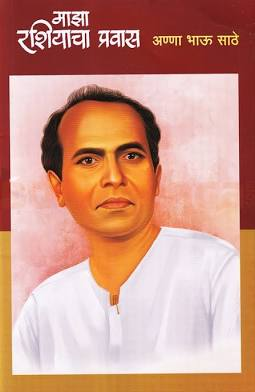
Anna Bhau Sathe’s connection with Russia was profound. Deeply inspired by the Russian Revolution and the works of authors like Maxim Gorky, Sathe saw strong parallels between the struggles of the Russian working class and the marginalized castes in India. Because many of his works had been translated into Russian, he was already a celebrated literary figure there before he ever visited.
The 1961 Delegation
In 1961, shortly after winning a Maharashtra government award for his masterpiece Fakira, Sathe was selected by the Indo-Soviet Cultural Society to visit Russia along with five other prominent Indian figures.
Before his departure, mill workers in Bombay gathered to see him off. They made a specific request: they asked him to look past the grand monuments, find the slums in Russia, and return to tell them what the lives of the poorest workers there were actually like.
Walking the Footpaths
Sathe took this request to heart. When his Soviet guides asked if he wanted to see the Kremlin or the Moscow Museum, he declined the standard tourist itinerary. Instead, he told his guides that he wanted to walk on the footpaths and observe the everyday people.
He spent his time walking the streets of Moscow, Leningrad (now St. Petersburg), and Baku. He keenly observed their socio-economic structures, the impact of modernization and machinery on labor, and the daily lives of the proletariat.
Maza Russiacha Pravas
Upon his return, he published a 58-page travelogue titled Maza Russiacha Pravas (My Journey to Russia). Unlike typical travelogues that focus on sightseeing and landscapes, Sathe’s account was a deeply sociological text. It detailed his micro-observations of the changes brought about by the Russian Revolution and analyzed what those societal shifts could mean for the anti-caste and labor movements back in India.
An Enduring Legacy in Russia
The respect was highly mutual. The Soviet government honored his visit by naming a road in Moscow after him. Decades later, his legacy in the country endures—recently, a statue of Anna Bhau Sathe was unveiled at the All-Russia State Library for Foreign Literature in Moscow, cementing his status as a global icon for the working class and marginalized communities.
Yes, Anna Bhau Sathe was deeply associated with the Communist Party of India (CPI), particularly during the 1940s and 1950s, though his ideological stance evolved significantly over his lifetime.
Here is how his association with the Communist movement unfolded:
Early Radicalization and the CPI
When Sathe migrated to Mumbai and began working in the textile mills, he was exposed directly to the harsh realities of class exploitation. The labor strikes and union activities in the city deeply influenced him, leading him to join the Communist Party of India. He became a card-carrying member and a staunch believer in Marxist ideology, viewing class struggle as the primary vehicle for social liberation.
The Red Flag Cultural Squad
His most significant contribution to the CPI was cultural. In 1944, alongside fellow working-class poets Amar Shaikh and D.N. Gavankar, Sathe founded the Lal Bawta Kala Pathak (Red Flag Cultural Squad).
- Operating under the umbrella of the CPI, this squad revolutionized traditional Marathi folk arts—specifically Tamasha and Povadas (ballads).
- Instead of traditional mythological or romantic themes, Sathe used these mediums to sing about workers’ rights, capitalist exploitation, and the Russian Revolution.
- The squad became incredibly popular across Maharashtra, acting as a powerful tool for Communist propaganda and mass mobilization among the rural and urban poor.
The Samyukta Maharashtra Movement
During the 1950s, the CPI was a major force in the Samyukta Maharashtra Movement (the struggle for a united, Marathi-speaking state with Mumbai as its capital). Sathe campaigned tirelessly for this cause under the Left’s banner. His songs and street plays were instrumental in taking the movement out of the hands of the urban elite and bringing it to the working-class masses.
Ideological Shift: Bridging Marx and Ambedkar
While Sathe was a committed Communist, he eventually grew critical of the mainstream Left in India.
He realized that the CPI leadership, which was largely dominated by upper-caste intellectuals, viewed inequality solely through the lens of economic class while ignoring the deeply entrenched reality of caste oppression. As a Dalit who had faced untouchability, Sathe knew that caste could not simply be reduced to a byproduct of capitalism.
This realization led him to the teachings of Dr. B.R. Ambedkar. In his later years, Sathe sought to synthesize Marxism and Ambedkarism. He famously dedicated his magnum opus, Fakira, to Dr. Ambedkar. While he never entirely abandoned his Marxist roots regarding economic equality, he asserted that in the Indian context, the fight against capitalism was incomplete without a simultaneous, aggressive fight against the caste system.
- apolitical titles ↩︎